


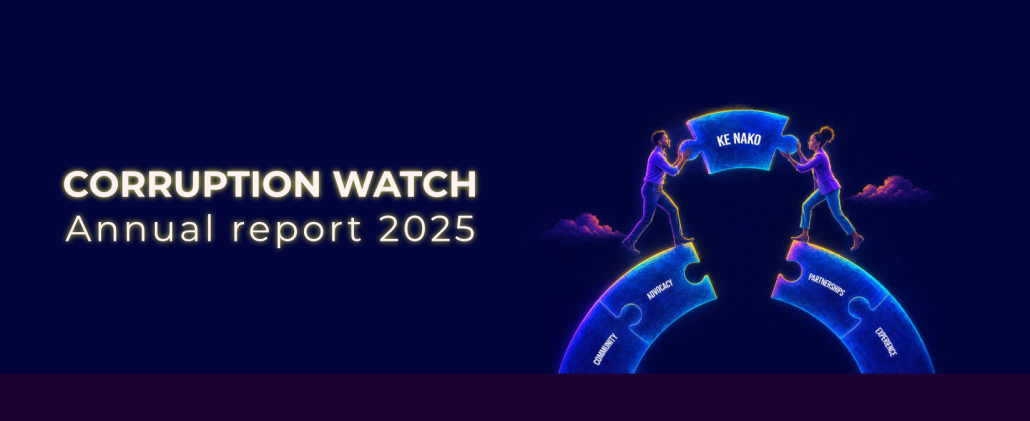
Corruption Watch (CW) today releases its 14th annual corruption report, titled Ke Nako: Mobilising for justice, as the organisation sets out on the new development path of Vision 2030 that will define its strategic direction for the next four years.
“We have chosen the theme for this year’s annual report, Ke Nako: Mobilising for Justice because we recognise the imperative for our society to demand justice and accountability from those in power,” says CW board chairperson Themba Maseko. “We want a move in the right direction, a move that shifts the dial even in global indicators like the Corruption Perceptions Index, which remained stagnant in 2025 for South Africa.”
We cannot leave it to law enforcement to fight the scourge of corruption alone, adds CW executive director Lebogang Ramafoko, as this sector is itself compromised to a worrying degree. “The whole of society should be invested and involved in the fight against corruption.”
Ke Nako highlights a wide range of focus areas during 2025, such as procurement, investigations, land corruption, leadership appointments, climate governance and integrity, gender and corruption, and the Strengthening Action Against Corruption project, among others.
In all these areas, we were heartened by whistle-blowers’ continual willingness to contribute to the fight against corruption, despite an ever-hostile reporting environment. They have been the cornerstone of this organisation from the outset, fulfilling our objective of amplifying the voices of people who have witnessed and been impacted by corruption first-hand.
Their reports have played a critical role in exposing how corruption occurs and impacts the lives of ordinary people, allowing the CW team to respond accordingly and to develop interventions and campaigns highlighting specific geographic and thematic focus areas, such as those indicated above.
CW 2025 data
In 2025, the organisation received a total of 2 222 corruption complaints, 91% of which were corruption-related. This amounted to an average of 185 reports a month, with significant peaks and lows in certain months. The primary channels for reporting were the website (60%), followed by the dedicated WhatsApp channel (23%), with e-mail constituting 16% of reports.
As in 2024, maladministration was the predominant type of corruption reported, with 408 cases, followed by fraud (330) and bribery/extortion (245). Other prevalent types of corruption included procurement irregularities (235), dereliction of duty (214), misappropriation of resources (209), and abuse of power (197).
The sector breakdown places policing (300 reports) once again at the top of the list, then basic education with 221 complaints. Third was business (219), followed by state-owned enterprises (SOEs) with 141, legal and financial services (101), construction (92), and traffic and licensing (82).
In terms of institutions, the highest number of reports (811) originated from provincial government entities, although many complainants chose not to identify them. In general terms, the South African Police Service is the most cited entity, followed by the education, justice, home affairs, and health departments. Corruption in local government accounted for 400 reports, while national government yielded 133 complaints, and SOEs 116.
In provincial terms, Gauteng remains the epicentre of reported corruption, with 993 cases and accounting for 45% of reports, with KwaZulu-Natal (249) in second place, followed by Limpopo (182), Eastern Cape (174), and Western Cape (173).
These five provinces collectively account for most reports, highlighting a concentration of governance challenges in urban and economically active regions.
Some highlights of 2025
Litigation: in August the Constitutional Court confirmed the invalidity of the March 2023 appointment of five commissioners to the Commission for Gender Equality by Parliament’s portfolio committee on Women, Children and People with Disabilities, ruling that the legislature failed in its constitutional duty to facilitate meaningful public participation in the appointment process. CW filed its challenge in December 2023.
Advocacy: in November our Land Corruption in Africa team appeared in Parliament with civil society project partners to demand answers for government’s failure to properly implement and monitor farm worker equity schemes.
Innovation: our Local Government Anti-Corruption Digital Technology Tool, developed under the EU-funded Strengthening Action Against Corruption project, went live in October. It is a citizen-focused platform promoting transparency, accountability, and civic participation in the Eastern Cape. Users can report corruption or service delivery incidents in their local government authority, while CW uses the data to evaluate corruption risks by area and provide advocacy support for communities.
“We are all affected by corruption and we have a responsibility to turn the tide against it. In 2026 CW aims to develop its vision 2030, which will outline its priorities for the next few years,” concludes Ramafoko. “We will build on our rich legacy and ask ourselves what role we would like to continue playing in the future.”
Download CW’s 2025 annual report.
For media enquiries contact:
Oteng Makgotlwe
Cell: 076 473 8336 E-mail: OtengM@corruptionwatch.org.za


