


Last month pan-African survey research network Afrobarometer released results of round 10 of its two-to-three-yearly surveys of South African attitudes and experiences in the social, political, and economic spheres. The tenth round took place in 2025 and the previous round, nine, took place in 2022.
The survey asks respondents to share their views of topics such as democracy, social media, gender issues, the environment, and corruption.
The latest results show people largely unhappy with democracy in the country, with 41.7% expressing complete dissatisfaction, 28.7% saying they are not very satisfied, and 21.3% saying they are fairly satisfied. Only 7.3% say they are very satisfied, while 0.8% say they don’t think South Africa is run as a democracy at all.
With municipal elections coming up in November, those dissatisfied customers will have the chance to use their vote to bring about the change they no doubt would like, at least at the community level. Municipal elections are crucial because this is the tier of government whose work directly impacts communities and where people interact most closely with the representatives who are supposed to be looking after their interests.
In this way local government is the tier that shapes lives every day, for good and for bad. “Local government elections … determine who leads your municipality, how budgets are allocated, and how essential services are delivered in your community,” says the Independent Electoral Commission (IEC).
“Decisions made at the local level affect your quality of life every day, from the condition of roads and public transport to waste collection, water and electricity services, community facilities, and local development projects. These elections have a real, local impact because they influence how your neighbourhood functions and how responsive local leadership is to community needs,” the IEC continues.
However, South Africans are not impressed with their government’s responsiveness and performance – not just in the local sphere.
Key findings and public concerns
“Corruption ranks fifth on South Africans’ list of priorities that government should address, cited by 21% of citizens, following unemployment (55%), crime and security (35%), water supply (31%), and infrastructure/roads (28%),” says Afrobarometer.
The other four are all pressing societal issues that are worsened by corruption, even though they are constitutionally mandated in the Bill of Rights. Furthermore, year after year, civil society organisations note a conspicuous lack of meaningful consequences for officials tasked with and failing at implementing projects that give effect to the rights set out in the Constitution – the highest law of the land.
Afrobarometer further notes that fully 77% of citizens think that corruption in the country increased “somewhat” or “a lot” in the past year. This is down slightly from 2022’s statistic of 82% but is still a significant and unacceptable number, showing that three out of four people surveyed believe this to be the case. The debate is still ongoing as to whether this perception is affected by the increased awareness of corruption that has developed over the years, thanks to efforts by organisations like Corruption Watch, and therefore more corruption is being noticed and reported – or whether corruption actually has increased.
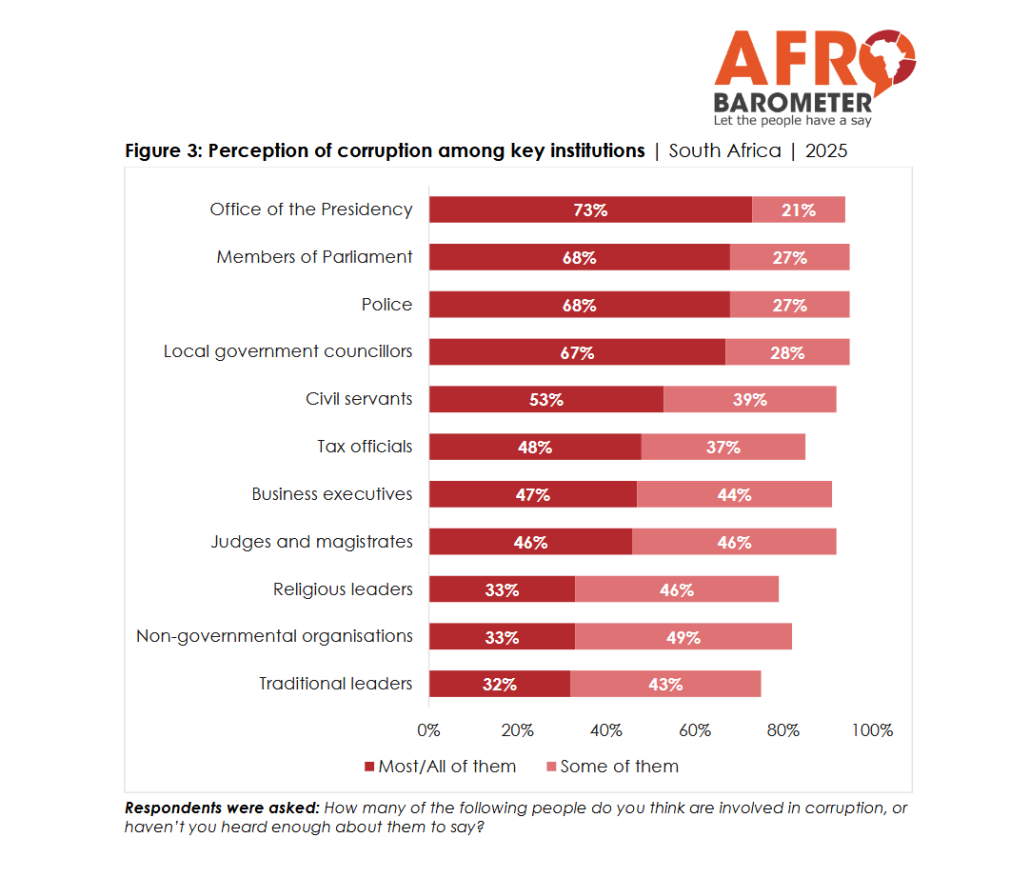
The results also reveal that respondents take a dim view of the levels of ethical conduct in the public service, suspecting that “most” or “all” officials in the office of the Presidency (73%), members of Parliament (68%), police officers (68%), local government councillors (67%), and civil servants (53%) are corrupt.

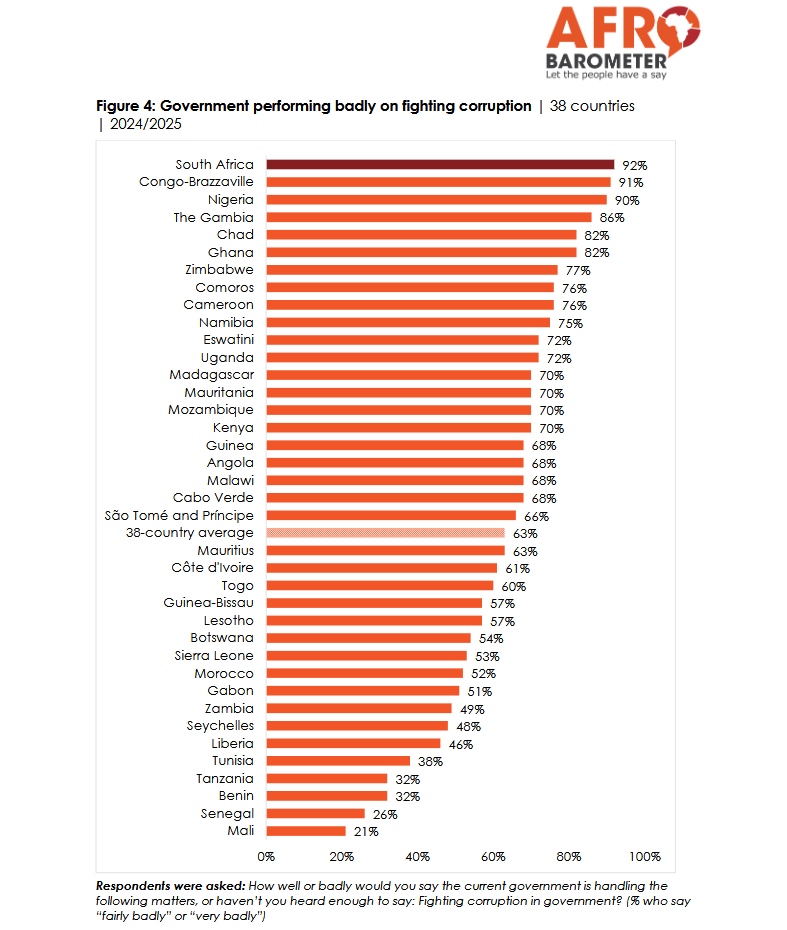
Such perceptions should be influencing the electorate’s decision as to whom they will give their valuable vote – not least in terms of how corruption is dealt with. Afrobarometer says most respondents (92%) are not impressed with the government’s fight against corruption – in their view these efforts are being handled “fairly badly” or “very badly”. This is “the largest share among 38 countries surveyed by Afrobarometer in 2024/2025”, meaning that South Africans give their government the worst rating on the continent as far as tackling corruption is concerned.

For those who do step up publicly to challenge the corrupt, the consequences can be dire. More than 83% of respondents say ordinary people risk retaliation or other negative consequences if they report corruption. This percentage has leaped by 20 points since 2018’s 63% and small wonder – the last few years alone have claimed the lives of heroes like Babita Deokaran, Cloete and Thomas Murray, Pamela Mabini, Thulani Maseko, Marumo Phenya, and Fikile Ntshangase, while there is still no justice many years later for Moss Phakoe and others who paid the ultimate price.
None of the masterminds behind these hits have been brought to book and their families still wait for justice – but we remember the names of the fallen.


