


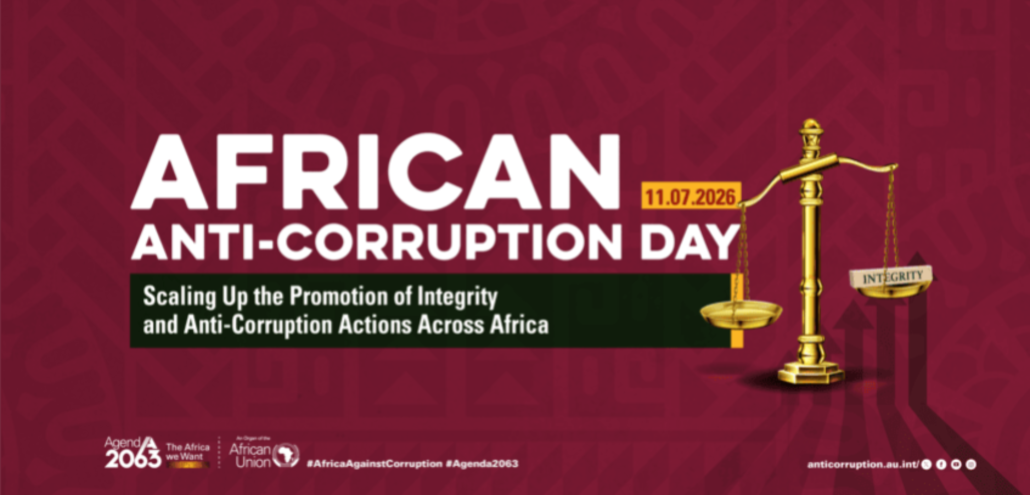
The theme for this year’s African Anti-corruption Day – held annually on 11 July – is Scaling up the Promotion of Integrity and Anti-Corruption Actions Across Africa. This, says African Union (AU) Commission chairperson Mahmoud Ali Youssouf, reflects the African Union’s vision of democratic governance founded on shared values. He stresses that continental integration requires trust among member states, and that such trust can only be sustained through integrity, transparency, and robust systems of accountability.
The event is a chance, says the AU, under whose auspices the event takes place, for all anti-corruption stakeholders to reflect and dialogue on the strategies and mechanisms taken in fighting corruption across the continent. The AU has its own continent-wide anti-corruption instrument – the AU Convention on Preventing and Combating Corruption (AUCPCC) – which was adopted on 11 July 2003 in Maputo, Mozambique.
Youssouf further reaffirms the Commission’s unwavering commitment to advancing integrity, transparency and accountability as indispensable pillars for achieving Agenda 2063: The Africa We Want.
Recalling the words of former UN Secretary-General Kofi Annan: “If corruption is a disease, integrity and transparency are the essential remedies for the rebirth of our continent”, he underscores that the fight against corruption is central to Africa’s development, peace, security and social justice. He also commends the AU Advisory Board Against Corruption (AUABC) for its continued leadership in promoting and implementing the AUCPCC – but emphasised that legal and institutional frameworks alone are insufficient and called for a broader cultural transformation that embeds ethics, integrity, and accountability across African societies.
Reaffirming the AU Commission’s support for member states, the chairperson encourages the adoption and implementation of national integrity and ethics strategies, while calling for stronger multilateral cooperation to accelerate asset recovery and harmonise anti-corruption efforts across the continent. He reiterates that combating corruption remains a strategic AU priority, and pledged the Commission’s continued support for the work of the AUABC.
Youssouf also calls upon governments, institutions, civil society, the private sector, and citizens to work collectively in promoting integrity and strengthening anti-corruption actions.
“The promotion of integrity and the fight against corruption are a shared continental responsibility. By scaling up our collective efforts, we can safeguard Africa’s resources, strengthen public trust and accelerate the realisation of Agenda 2063 for the benefit of present and future generations,” he says.
Promoting the AUCPCC
As part of its support of AACD and the AUCPCC, Transparency International (TI) in 2022 released an advocacy toolkit for African CSOs whose advocacy work includes pushing for compliance with the convention.
The convention, said TI, provides a roadmap for AU member states to implement good governance and anti-corruption policies and systems. Such implementation is by no means certain, and CSOs across the continent have relentlessly pressed lethargic governments to meet those AUCPCC commitments.
Titled Promoting the African Union Convention On Preventing and Combating Corruption: Tools and Tactics, the TI toolkit collects various advocacy and accountability strategies developed by TI chapters in Côte d’Ivoire, Rwanda, Senegal, South Africa and Tunisia in four particularly problematic areas – money laundering, illicit enrichment, political party funding, and civil society and media. These strategies are designed for each country’s individual set of challenges, and other CSOs may replicate or tailor them to their own situations.
The TI toolkit is part of a larger package of guiding material produced under the umbrella project Towards Enforcement of African Commitments Against Corruption, which was completed in 2022. Other documents include:
- TI’s Implementing and Enforcing the African Union Convention on Preventing and Combating Corruption – A Comparative Review, 2020.
- South Africa feature article on impact.
- Tunisia feature article on impact.
- Rwanda feature article on impact.
- Cote d’Ivoire article on impact.
The guide provides real examples of creative advocacy work to promote the AUCPCC, said TI, but emphasised that “they are not to be considered the very best practice but rather an illustration of an advocacy approach”.


