|
Getting your Trinity Audio player ready...
|
| SAAC HOME AND LATEST NEWS | ABOUT THE SAAC PROJECT | SAAC INFORMATION AND RESOURCES |
WELCOME TO THE Strengthening Action Against Corruption (SAAC) Project MINI-SITE!

This is the home page of our SAAC mini-site, and here you’ll find a short introduction to the project, as well as the latest news and developments, from report launches and other valuable information to activities and events. To see other pages in this mini-site, use the navigation aid just below the main image on this page, or simply click on About SAAC or SAAC information and resources for more information.
Our corruption reporting tool for the Eastern Cape has a new name!
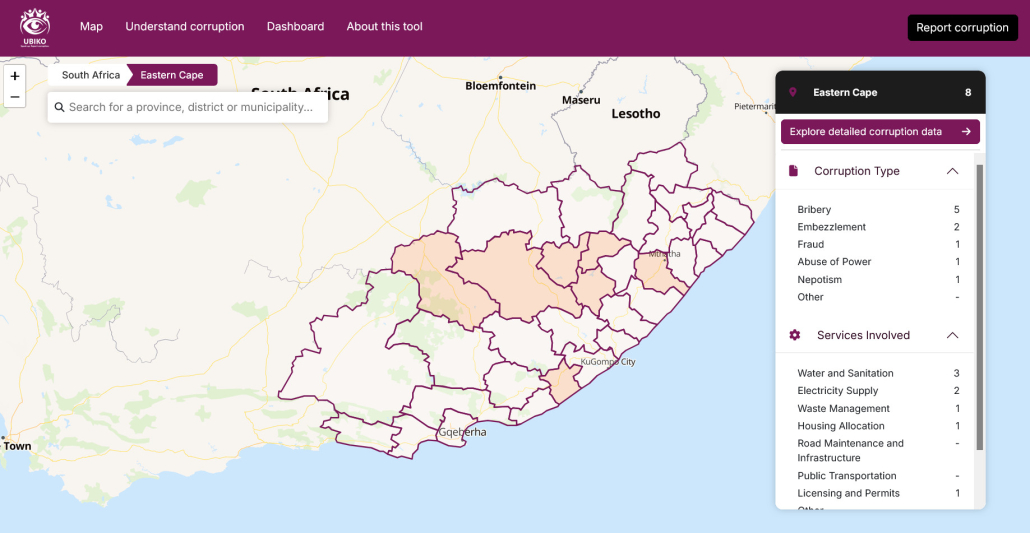
The Ubiko corruption-reporting tool is a citizen-focused platform developed in response to the real challenges of municipal governance. Ubiko provides easy access to information on public services, municipal budgets, service delivery performance, and the roles and responsibilities of local officials. Its user-friendly interface guides citizens in recognising red flags of corruption and offers secure, anonymous channels for reporting misconduct – helping to protect whistle-blowers and promote accountability.
Why Ubiko?
In isiXhosa, the word ubiko comes from the verb root -bika, which means to report, announce, or bring news (often serious, official, or formal news).
When applied specifically to reporting corruption, ubiko carries deep cultural and civic weight:
- Sounding the alarm: It functions as a formal whistle-blowing or disclosure mechanism. It is the official act of bringing a hidden wrong (like urhwaphilizo – corruption) to light before an authority or the public.
- A civic duty: Historically, ukubika is used when someone goes to the elders, leadership, or community structures to report a significant incident or threat. In modern anti-corruption work, using the term ubiko reframes whistle-blowing not as “snitching,” but as a responsible, necessary act of civic duty to protect collective resources.
Essentially, ubiko is the bridge between witnessing malpractice and initiating accountability.
About Ubiko
- It is a citizen-focused digital platform designed to promote transparency, accountability, and active civic participation in local government.
- It is developed under the Strengthening Against Corruption (SAAC) project and funded by the European Union.
- It’s implemented by Corruption Watch, Social Change Assistance Trust, and Transparency International.
- Ubiko empowers residents to identify, understand, and anonymously report corruption-related issues affecting their communities.
- Ubiko serves as a hub for civic education, offering practical resources to support community-based organisations (CBOs) and individuals in engaging meaningfully in local governance processes.
Click on the map to go to Ubiko.
The latest SAAC news
SAAC corruption risk assessment reports – August 2026
Download our corruption risk assessment reports for five Eastern Cape municipalities: Nelson Mandela Bay Metropolitan Municipality, Umzimvubu Municipality, Senqu Municipality, Buffalo City Metropolitan Municipality, and Makana Municipality.
Buffalo City Metropolitan Municipality
SAAC case studies and policy brief – August 2026
Download our new publication, titled SAAC PROJECT: PROVINCIAL CASE STUDIES AND POLICY BRIEF, EASTERN CAPE.
This policy brief documents field evidence gathered by community-based organisations and civil society partners participating in the SAAC Project across the Eastern Cape. Through systematic community monitoring, stakeholder engagements, and grassroots advocacy, participating organisations have recorded widespread and recurring failures in water provision, housing delivery, and road infrastructure maintenance.
NEW: educational brochures – August 2026
Download our educational brochures that shed some light on essential municipal functions such as budgeting and procurement, and give advice on problems such as being denied information that should be public.
Procurement processes in local government
How municipal budgets are made and spent
Key service delivery responsibilities of municipalities
Code of conduct for municipal staff and procurement oversight
NEW REPORT – Strengthening Accountability in Local Government – August 2026
Download our new report, titled Strengthening Accountability in Local Government: A Corruption Risk Assessment of Eastern Cape Municipalities, South Africa.
The SAAC team presents findings from a corruption risk assessment of nine municipalities in the Eastern Cape province. Key findings show that corruption risks are concentrated within financial management, procurement, and recruitment systems. Despite these challenges, the assessment also identified pockets of resilience, which are also discussed.
SAAC stories from the ground
Corruption is undoubtedly a serious problem in South Africa and all provinces, with no exceptions, face its repercussions in the form of poor service delivery and improper management of resources. Residents of the Eastern Cape, however, have seen a new wave of activism brought about by the SAAC project.
Below we publish some of the anti-corruption community action undertaken as part of SAAC. We will add to these on an ongoing basis, so visit this page regularly. Click on the headings below to expand the stories, and click again to condense them:
When taps run dry and promises fail: the silent crisis of Mount Fletcher
Mount Fletcher is a rural community that has for years experienced deep‑rooted service delivery challenges affecting the daily lives and dignity of residents. These challenges include deteriorating access roads, poorly constructed bridges, inconsistent electricity supply, inadequate water provision and unresolved issues relating to RDP housing. Collectively, these conditions have entrenched poverty, restricted access to essential services and undermined trust between the community and the local municipality. The most acute crisis emerged when the community was subjected to a prolonged interruption of water supply, highlighting broader governance and accountability failures within the municipal system.
In the region’s rugged terrain, where the R56 winds toward Matatiele, the beauty of the Eastern Cape landscape is frequently overshadowed by the harsh realities of municipal neglect. For the residents of the Elundini Local Municipality, basic necessities such as water, electricity, and safe roads have become luxuries that are fought for but rarely delivered.
The crisis reached a breaking point in July 2025, when residents from 10 different wards, exhausted by years of empty promises, took to the R56 in protest. Their hope was simple: to be heard by the mayor. Instead of answers, they were met with rubber bullets and police reprimands. Today, the scars of those protests remain mirrored by the crumbling infrastructure and the dry taps that continue to plague the community.
The heavy burden of a waterless town
The immediate trigger for community mobilisation was a sudden interruption of water supply across Mount Fletcher. Residents went without running water for two full weeks after an infrastructure failure within the municipal water system. Despite repeated complaints lodged with the municipality, no meaningful repairs were undertaken and no clear communication was provided regarding timelines for restoration. The absence of water severely affected households, schools, clinics, and early childhood centres.
Although the municipality later offered JoJo tanks as an alternative water source, distribution was inconsistent. Many residents were unable to access the water deliveries because they were at work or at school at the time of delivery, effectively excluding significant portions of the community.
The effects of these failures were felt most acutely by vulnerable groups.
- Women with young children, older persons, and people living with disabilities bore the heavy physical burden of collecting water from distant sources.
- Compromised hygiene and sanitation increased the risk of disease, while many households faced financial strain from having to purchase water privately.
- Schools, clinics, and hospitals struggled to operate under water‑scarce conditions.
- Poorly maintained roads and unsafe bridges restricted mobility, preventing pensioners from accessing social grants and essential medication, particularly those with chronic illnesses.
- Learners were frequently delayed or placed at risk when travelling long distances on slippery, pothole‑ridden roads, especially during periods of heavy rainfall.
These failures also amounted to serious violations of constitutionally protected rights.
- Section 27(1)(b) of the Constitution of the Republic of South Africa (1996) guarantees the right to access sufficient water and healthcare, a right clearly undermined by the prolonged water outage.
- Section 29, which protects the right to education, was compromised as learners struggled to attend school on time or study effectively due to infrastructure failures and unsafe roads.
- Section 26, which affirms the right to adequate housing, was implicated through ongoing challenges with RDP houses.
These infringements collectively illustrate how service delivery failures can translate directly into human rights violations.
Community response
The water crisis was not an isolated issue but part of a broader pattern of unresolved service delivery failures. In July 2025, residents from 10 wards collectively demanded action on long‑standing concerns, including poor roads, unsafe bridges, electricity shortages, lack of clean water, and inadequate housing. After years of what they described as false promises, community members resorted to blocking the R56 road between Mount Fletcher and Matatiele in an effort to draw the attention of the Mayor of Elundini Municipality.
Rather than constructive engagement, the protest was met with force. Police officers, acting under instruction, responded with rubber bullets. This response not only physically injured community members but deepened feelings of exclusion and repression among residents who were attempting to assert their rights.
Educating for accountability
The Mount Fletcher Advice Centre took proactive steps to support the community, educating residents about their constitutional right to water and other basic services, and empowering them with knowledge to assert these rights lawfully. It also raised public awareness through social media, amplifying community voices beyond local boundaries. Crucially, the centre encouraged active community participation in municipal processes such as Integrated Development Plan (IDP) meetings, budget planning sessions and local leadership structures. This approach aimed to strengthen transparency, promote accountability, and ensure that residents could monitor municipal commitments and expenditure.
This intervention helped attract public attention and placed increased pressure on the municipality to respond. As a result, JoJo tanks were provided and water deliveries resumed, albeit as an interim solution. More importantly, residents became increasingly aware of their rights and their role in governance processes. Community members gained confidence to voice complaints, participate in decision‑making, and hold municipal authorities accountable for failed projects and unfulfilled promises. This shift marked an important step toward community‑driven oversight and long‑term advocacy.
From protests to the boardroom
The Mount Fletcher Advice Centre recognises that while rubber bullets may silence a crowd, they cannot extinguish a community’s constitutional rights. Under the Strengthening Action Against Corruption (SAAC) project, our organisation has pivoted from mere observation to active empowerment.
We have launched a series of education campaigns, teaching residents that Section 27 of the Constitution – the right to access sufficient water and healthcare – is not a suggestion. It is the law. By raising awareness on social media and in community halls, we are transforming “frustrated residents” into “active citizens.” We plan to expand education and awareness campaigns on constitutional rights, including equality, dignity and freedom of expression.
Our goal is to move the battle from the barricades of the R56 to the decision-making tables of the municipality. We are encouraging the community to:
- Reclaim the IDP: By attending Integrated Development Plan (IDP) meetings and budget sessions, residents can monitor exactly where funds are allocated.
- Form leadership committees: Establishing community-led oversight ensures that when a bridge project fails or water funds vanish, the municipality can no longer hide behind “empty promises.”
- Whistle-blowing: We are advocating for a culture of transparency where government workers are encouraged to expose corruption from within, protected by a network of silent monitors.
The organisation aims to offer legal advice to victims of rights violations, monitor service delivery compliance, and protect community members who speak out against abuse. It also advocates for whistle‑blowers within government institutions to expose corruption.
A call for reinforcements
The Mount Fletcher Advice Centre is standing firm, but the mountain we are climbing is steep. To be effective, the organisation requires legal expertise, financial resources, technological equipment, safety measures, and stronger collaboration with other stakeholders and government institutions. These supports are essential to ensuring that constitutional rights in Mount Fletcher are not only recognised but fully realised.
We require:
- Legal expertise: Access to legal counsel to pursue accountability measures against non-performing authorities.
- Technological resources: Computers and educational materials to ensure every resident has a copy of their rights in their hands.
- Safety and security: Measures to protect whistleblowers and community members who dare to speak out against abuses of power.
The story of Mount Fletcher is currently one of hardship, but through the SAAC project, we are drafting a new chapter, one where the constitutional rights of every resident are not just written on paper but are realised in their homes.
From paper to power: Libode’s DELTA secures a seat at the table
Libode, a region in the Nyandeni Local Municipality, is a place where the resilience of the community often stands in stark contrast to the stagnation of its infrastructure. While the Eastern Cape is frequently celebrated for its natural heritage, for the residents of Nyandeni, the view is often marred by the sight of unfinished RDP houses, skeletons of promises that leave families without the dignity of proper shelter.
Infrastructure failures here are not just administrative oversights; they are daily hardships. Poor road networks and failing sanitation systems strip away the basic constitutional rights of the community, fostering a deep-seated sense of frustration. When local government remains a distant, silent entity, the people feel their voices no longer carry weight. It is this gap between the governed and the governors that the Development Education and Leadership Teams in Action (DELTA) sought to bridge.
Breaking the cycle of postponement
Recognising that accountability cannot be demanded from the sidelines, DELTA launched the Strengthening Action Against Corruption (SAAC) project. The mission was clear: hold the Nyandeni Local Municipality accountable for its service delivery failures. However, the path to engagement was initially blocked by a wall of bureaucracy and repeated postponements of physical meetings.
Refusing to let the initiative stall, the DELTA team pivoted. In August 2025, they bypassed the logistical hurdles by convening a virtual meeting with the mayor of Nyandeni. It was here that the SAAC project was first introduced not as a threat, but as a necessary mechanism for transparency. The mayor endorsed the project, opening the doors to the municipal risk and fraud management officer and the public participation officer.
A formal pact for accountability
The turning point came when municipal officials suggested that the relationship be codified. DELTA moved swiftly to draft a memorandum of understanding (MoU), a document designed to transform informal support into a binding working relationship.
On 12 December 2025, the municipality officially signed the MoU. This was a landmark victory for Libode. It shifted the dynamic from one-sided complaints to a structured partnership. With this document, DELTA is no longer just a community observer; it is a formal stakeholder with the right to sit across from municipal leaders and demand answers.
The path forward: holding the line
The first formal meeting under this new framework took place on 5 February 2026, coordinated by the municipal operations manager. The primary objective is the establishment of a joint working committee. This committee will serve as a direct pipeline where documented cases of service delivery failures; the dry taps, the crumbling houses, and the broken roads are submitted for immediate review and remedial action.
DELTA’s accountability work has also moved beyond the municipality. The team had a direct engagement with the district director of the Department of Human Settlements that took place on 18 March 2026. The director acknowledged the failures on record and committed to convening a full accountability session, one that would bring together every party involved in the original RDP housing projects and require them to account for the state of those houses. That meeting has not yet taken place. Before it could be scheduled, a fire broke out at the department’s offices in the Botha Sigcau Building. The damage to the department’s operations has created significant delays in the process. DELTA continues to press for the meeting to be convened.
DELTA’s strategy moving forward is multi-pronged:
- Persistent oversight: Using the MoU to ensure regular, scheduled engagements that the municipality cannot easily ignore.
- Community empowerment: Running education workshops to teach residents how to report issues effectively, ensuring the “grassroots” remain the loudest voice in the room.
- Escalation: Where local action falters, DELTA is prepared to take these documented failures to district, provincial, and national oversight bodies.
In partnership with the Social Change Assistance Trust (SCAT) and Corruption Watch, DELTA was part of the delegation that took its documented evidence of service delivery failures directly to the Eastern Cape Provincial Legislature. The delegation appeared before the Committee of Chairpersons. The committee received them and gave a firm undertaking to support civil society organisations in the work of holding government accountable. Members committed to raising the specific issues presented with the relevant oversight authorities, giving the people a formal hearing at the level of provincial oversight.
The SAAC project, supported by partners like Corruption Watch, the Social Change Assistance Trust, and Transparency International, is proving that in the Eastern Cape, the fight for administrative justice is becoming more organised. For DELTA, the signed MoU is not the end of the journey, but the beginning of a new era where the people of Libode are no longer spectators to their own neglect.
Eroding trust and land: Infrastructure failure in Umzimvubu
For more than five years, severe donga (gully) erosion has expanded across all 28 wards of the Umzimvubu Local Municipality, particularly affecting the Mount Frere area. These dongas have caused widespread environmental degradation, threatened public safety, and damaged roads, bridges, and agricultural land. Despite repeated public complaints, the municipality initially failed to take corrective action, attributing the problem to ongoing national road construction, rather than addressing the root causes of erosion.
Failure of infrastructure and governance
The unchecked expansion of dongas represents a clear infrastructure failure. Roads and transport networks have deteriorated to the point where access to clinics and hospitals has become difficult and, in some cases, dangerous. This has resulted in delayed medical treatment for vulnerable community members. Farmers have also been severely affected, as damaged roads prevent them from transporting produce to markets, undermining livelihoods and local food security.
As basic services declined, households were forced to spend limited incomes on alternative solutions such as private water trucks and generators, deepening existing poverty. The continued inaction by the municipality raised serious concerns about accountability and governance at local level.
Violation of constitutional and legal obligations
The situation constituted an infringement of several constitutional and legislative provisions. Sections 152 and 153 of the Constitution of the Republic of South Africa (1996) place a duty on municipalities to ensure sustainable service delivery and to promote a safe and healthy environment. In addition, the Bill of Rights (Chapter 2) and the Municipal Structures Act of 1998 require local government structures to prioritise community well-being and participatory governance. The failure to address the donga crisis represented a breach of these obligations.
Community action and legal advocacy
In response, the Mount Frere Paralegal Advice Centre, based within the Umzimvubu Local Municipality, played a critical advocacy role. The organisation advised traditional leaders from affected areas to submit a joint complaint, strengthening community voices and increasing the likelihood of official response. The matter was also escalated to the Department of Justice to ensure formal oversight and accountability.
This coordinated approach shifted the issue from isolated complaints to a collective human rights concern, compelling authorities to engage more seriously with the problem.
Outcomes and continuing oversight
As a direct outcome of these actions, a formal briefing was held between 25 August and 5 September 2025. During this period, the rehabilitation project was initiated. The municipality committed to a R5-million project to address donga erosion across all 28 wards, marking a significant step towards restoring infrastructure and environmental safety.
To safeguard progress, the Mount Frere Paralegal Advice Centre has committed to maintaining constant communication with the designated government representative and participating in municipal public meetings to ensure transparency and follow-through.
Future plans and sustainability
This case highlights the importance of sustained community mobilisation, legal literacy, and institutional support in realising constitutional rights. The Mount Frere Paralegal Advice Centre has identified the need for further training in legal frameworks, stronger partnerships with anti-corruption bodies, access to pro bono legal support, and multi-year funding to ensure continuity of advocacy work.
From promise to neglect: RDP housing failure in Nyandeni Local Municipality
In 2014, the Sikhuza family was approved as beneficiaries of a government‑subsidised RDP house under South Africa’s public housing programme. Like many low‑income families, they viewed this allocation as a critical step towards dignity, safety, and stability. The house was meant to provide adequate shelter for a household of nine people and restore their constitutional right to housing. However, what should have been a life‑changing moment, instead became a prolonged experience of neglect and frustration.
Nature of the problem
The contractor responsible for constructing the Sikhuza family’s house abandoned the project before completion. The structure was left in a clearly uninhabitable condition, with no plastering, no glass fitted in the window frames, no internal ceiling, and no installed doors. As a result, the house was completely exposed to the weather and could not be occupied.
After some time, the contractor briefly returned and carried out partial plastering. This work was poorly done, with uneven surfaces and large areas where the plaster cracked and later fell off. Crucially, the contractor failed to complete the remaining work and once again left the site. No windows, doors, or ceiling were installed, and no repairs were made to correct defective workmanship. Since then, the house has remained unfinished and unused.
Violation of rights and legal standards
This case represents a clear violation of the right to adequate housing as enshrined in Section 26 of the South African Constitution. Furthermore, it contravenes the Housing Act 107 of 1997, which obliges the state to ensure that housing delivery meets acceptable standards. The National Housing Code further outlines minimum requirements for RDP houses, including completed structures with secure doors, windows, and appropriate finishes. None of these standards were met in the Sikhuza family’s case.
Impact on the family and community
For more than ten years, nine members of the Sikhuza family have been unable to occupy the house they were allocated. The unfinished structure continues to deteriorate due to ongoing exposure to rain and wind, worsening the damage and increasing the cost of eventual repairs. Beyond the personal hardship faced by the family, this case reflects a broader pattern of housing delivery failures in Nyandeni Local Municipality, where contractors often abandon projects or deliver poor‑quality workmanship without consequence.
Actions taken by Development Education and Leadership Teams in Action (DELTA)
DELTA visited the Sikhuza household to assess and document the condition of the unfinished house. Photographic evidence was collected to show the missing doors, windows, ceilings, and the poor state of plastering. The organisation also recorded the family’s account of their interaction with the contractor. The case has since been formally included in DELTA’s documentation of housing failures under the SAAC project in Nyandeni Local Municipality.
Current status and way forward
At present, the case remains in the documentation phase. Evidence has been gathered, and preparations are underway to formally engage with municipal officials. The next step is to present the Sikhuza case, alongside other documented housing failures, to Nyandeni Local Municipality under an existing memorandum of understanding. DELTA aims to use this process to demand accountability, corrective action, and the realisation of constitutional housing rights for the Sikhuza family and other affected residents.
The beauty of Alicedale eclipsed by hardships for locals
It is often lauded as one of the most picturesque areas of South Africa, with green hills that span over hundreds of kilometres. Nestled in the Makana Local Municipality, the region of the Eastern Cape province, Alicedale is a small town that boasts some of the country’s most loved game reserves. Among these is the world-famous Addo National Elephant Park.
Municipalities.co.za describes it in this way: “The Makana area has nearly a million hectares devoted to game. A range of public and private nature reserves span the area, from the world-famous Shamwari in the west to the magnificent Double Drift and Kwandwe Reserves in the east.”
Anyone reading about Alicedale would imagine these tourist attractions bring good economic opportunities that boost the tourism sector for this semi-rural community and surrounding areas, but this is not necessarily the case. Many of Alicedale’s residents are aggrieved over what they describe as neglect and disregard from their municipality. The tourist attractions – renowned as they are – come at a cost for them of irregular supply of clean water, an issue that has plagued the area for a long time, with little or no acknowledgement from the municipality.
Community leader and CARE Alicedale director Phumla Gojela calls it an injustice and infringement of the constitutional rights of residents. They have to struggle to access water and when it does reach their taps, it is often not of the best quality for drinking.
“Alicedale’s water supply system was compromised after the municipality allowed the privately owned game reserves to draw water from the local dam and river for the benefit of the wild animals,” says Gojela.
“The situation worsened when an old farm owner started his own privately owned game reserve. The farmer built a brick wall around the dam nearest to him, blocking the natural flow of water to our river. This has further reduced our access to water. This was clearly visible during the Covid-19 pandemic in 2021.”
Half-hearted municipal effort
The urgency for CARE Alicedale was in addressing the matter with Makana. Gojela told the Strengthening Action Against Corruption (SAAC) team that numerous complaints were made to the municipality, with CARE providing evidence in the form of pictures, of residents resorting to walking far to fetch water from the river.
Makana’s response was to provide water tankers, a solution that ensured the provision of clean water, but was not sustainable in the long term.
SAAC was launched in 2024 with a team from Corruption Watch, the Social Change Assistance Trust, and Transparency International charged with identifying CBOs across the Eastern Cape to lead mobilisation efforts for administrative accountability from local government, from the ground. The CBOs are encouraged and have been trained through various workshops held in 2024 and 2025 to raise awareness about service delivery challenges in their communities as well as how to hold public institutions at local government level accountable to the service delivery principles of the Constitution.
No community consultation
Gojela says for the most part, the grievances that Alicedale residents have with their municipality stem from years of poor service delivery and planning for all residents, not just the tourism-focused businesses. The community does not get consulted in terms of spatial planning by the municipality as well as the allocation of services such as water. Over time, this has resulted in community members having to regularly fetch water from springs and other natural sources in the area that are also used by game.
This has created challenges for small businesses in the area and for many in the community who have to factor in the task of fetching of water into their daily schedules. Some of these are schoolchildren who end up missing out on crucial learning time. Although Gojela acknowledges that developing the area’s tourism sites over the years was good, it should not have been at the expense of the communities that are now neglected and without clean drinking water. She is of the view that they were also not prioritised in the planning process for the area.
Taking on the war on poor water supply from the ground
The community of Qongqotha village in Qonce in the Eastern Cape has taken on the Amatola Water Board (AWB), demanding that it addresses issues of poor and irregular water supply and damages to homes caused by what they say is a poorly planned construction of a reservoir in their area.
The ability to own land in South Africa is a privilege that not many can claim. So, when one lives in a poor, rural area with little or no development, it becomes a source of pride for their family. For many such families across the rural areas of the Eastern Cape, the harsh realities of unemployment and poor or no development bite harder when they have to fight to keep their homes safe from harmful infrastructure development projects. Some of them live in Qongqotha village in Qonce, formerly King Williams Town, in East London. It is one of numerous villages that fall under the Buffalo City Metropolitan Municipality. Qongqotha is home to about 1 300 residents and is made up of just over 300 families.
As with many other areas of the Eastern Cape, development in the supply and management of water infrastructure has been slow, with the area relying on a bulk water service system administered nationally by the Department of Sanitation. Several years into the advent of the reconfiguration of the province’s regions after 1994, the Amatola Water Board (AWB) was established as one of nine across the country that oversee water infrastructure development and supply management in the provinces.
Qongqotha’s turn to get its own improved reservoir initially began in 2009 in an effort to improve water supply services in the area. But some time into the project, challenges arose about the choice of location for the construction of the infrastructure. Some residents’ homes stood in the planned path of the pipelines to be installed, but the work had already started when this was discovered. Some residents were receptive to relocation offers, while others were not prepared to relinquish their homes. To avoid damages to the homes that had not been demolished, some of the pipelines were rerouted, but for some families this action came too late, with damages to their houses already visible.
Demanding accountability
Nomiki Mathosa is a community activist and coordinator with Entlango Primary Agricultural Cooperative. For the most part her role has involved advocating for accountability from institutions offering services to the people of Qongqotha and surrounding areas.
She cites one elderly resident of Qongqotha, whose name is known to Corruption Watch (CW), as one of the people who have brought complaints to Entlango seeking help. According to Mathosa, the resident recounted how as far back as 2014 his complaints to damage to his home, which he noticed prior to the recent renovations, did not yield results. The ground around his home always becomes waterlogged due to leakages from the pipes that run underground. More damage came, however, with the recent construction: some of the walls of his house had started to crack from the pressure caused by the drilling nearby. Entlango committed to following up with AWB on his behalf, but their efforts too would go unresolved.
The team resolved early in 2025 to conduct an audit of all affected households to make for a stronger case with AWB. A site visit to the construction area was arranged for 22 August 2025, with an AWB management team meeting Entlango representatives, followed by another communication lull until a follow-up letter was sent, requesting commitment to the points discussed during the site visit.
It was only after the letter, in which several stakeholders such as the provincial public protector’s office and CW were copied, that Mathosa received a response to a request for a community meeting meant to provide residents with a platform to speak out about their challenges.
Mathosa explains: “There was no proper consultation where the people can say it was a response maybe to water shortage or wanting to expand areas of separation for the department of water affairs or Amatola… what came to the village is that a new reservoir is going to be built, but for people to have a proper understanding of why it was being extended, there was no consultation.”
She adds that the development was done haphazardly, with only the elder members of the community being able to recall that there had been talks of building a reservoir in the distant past. Some residents feel aggrieved that the urgency of the impact of the poor construction is not recognised by either the AWB or the municipality. “All the houses within a certain radius from the construction site have mould,” Mathosa explains.
Part of an organised movement
Entlango is one of about 20 community-based organisations across the Eastern Cape that were earmarked to be part of the Strengthening Action Against Corruption (SAAC) project in 2024. The programme specifically targets community advice offices/civil society organisations (CSOs), equipping them with the knowledge and resources needed to identify and address corruption and gaps in accountability in relation to service delivery. By supporting these organisations in mobilising their communities, SAAC fosters a culture of accountability and transparency that is fundamental to anti-corruption efforts in South Africa.
The SAAC partners include CW, the Social Change Assistance Trust, and Transparency International, with each organisation playing a different role. For cooperatives like Entlango, the support both financial and otherwise has meant that mobilising communities that are affected by poor service delivery is more organised and structured.
On 11 November, the officials at Entlango facilitated a meeting at which an AWB delegation, along with the ward councillor for their area, were invited to address the community and hear of their struggles with getting regular water supply. From the pipe leakages to the dry taps in their community, they made their case, and were promised that their grievances would be addressed.
Emboldened by the community’s eagerness, Entlango’s next step is to submit an advocacy report to the provincial government, with the help of CW. The report notes: “At this meeting, the management team listened to the issues and informed the delegation that the grievances would be referred to AWB’s head office in East London.”
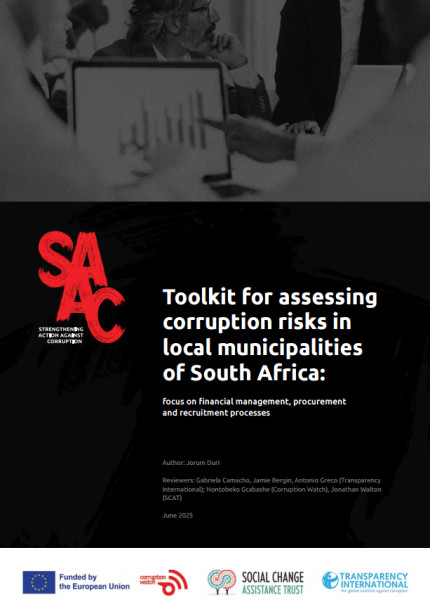
Toolkit for assessing corruption risks in local municipalities of South Africa – December 2025
Download our new Toolkit for assessing corruption risks in local municipalities of South Africa.
The SAAC team has developed a bespoke corruption risk assessment toolkit to generate evidence on corruption risks within local municipalities in South Africa and use the evidence to advocate for reforms. This will strengthen the capacity of community-based organisations (CBOs) and community advice offices (CAOs) in the Eastern Cape to develop and advocate for context-specific responses to corruption. Their proximity to local communities enables these organisations to uncover corruption and its risks that may otherwise go unnoticed, and advocate for targeted interventions that resonate with local realities.