|
Getting your Trinity Audio player ready...
|
It’s another year at the polls for South Africa, with the focus this time on municipalities. At the end of 2026, citizens will vote for their local government representatives in an election that will take place between 2 November and 1 February 2027.
This is a crucial event in the democratic system because local government is the sphere closest to the lives of ordinary people – the one that provides essential services, that brings people into the democratic system and allows them a voice in decisions that affect their lives, that realises the human rights provided for in the Constitution by addressing inequalities at community level.
Or at least, on paper.
There is nothing we can say in this article that has not already been said about the quality of municipal governance. Suffice it to say that political analyst Kenneth Mokgatlhe summed it up succinctly in 2021. “It is quite embarrassing that, 27 years after the apartheid regime, we are still talking about shortages of water and poor sanitation. We should be talking about ways in which we could be growing the economy and, above all, creating a more capable state that responds effectively to the current socioeconomic challenges,” he wrote.
“Those residents certainly know how to assess the effectiveness of local governments, as their daily lives are harshly affected by the absence of such services,” he added.
Not much has improved in the five years since those words were published. It follows, therefore, that just as the 2024 national elections brought about much-needed change to the political landscape, so too must the same consideration be given to the upcoming local government elections.
People need depth of knowledge to be able to make an informed decision on with whom to entrust their vote, and who is more capable of delivering the services municipalities are mandated to provide. Fortunately there are many resources available to help voters get to the bottom of any questions they may have, including sources mentioned in paragraph two of the section below.
Municipal corruption rife
Romi Sigsworth, a research consultant with ENACT and the Institute for Security Studies (ISS), postulates that the local government failure constitutes a form of organised crime. In a policy brief published by the two organisations, she explains that the document “examines the extent to which corruption in South Africa’s municipalities is organised and how understanding this organisation might inform stronger prevention and enforcement measures”.
From a literature review of the intersection between organised crime and corruption, Sigsworth developed a draft framework which she used to explore how these connections manifest in local government. She then took three case studies from each level of local government – Madibeng local municipality, OR Tambo district municipality, and City of Johannesburg (CoJ) metropolitan municipality – and inserted them into the framework. The case studies were drawn from information in the public domain, including Auditor-General, Special Investigating Unit, and portfolio committee reports, the Governance Performance Index (GPI) 2024, news articles, and investigations.
The study was founded on a typical chain of events starting with motive and followed by inappropriate influence, access to resources and information, protection of illicit activities, and impact. It found that groups do indeed co-ordinate according to the steps laid out, to obtain private benefits by misusing entrusted power.
South Africans have become much more aware of the presence of organised crime in our society in recent years. From the Global Initiative Against Transnational Organized Crime’s regular reports and monitoring on the growing phenomenon in South Africa, to the disturbing revelations of organised criminal activity in the criminal justice system coming out in the Madlanga commission and ad hoc committee
Findings of the policy brief
In terms of influence, in all three case studies Sigsworth immediately picked up the usual patterns of irregular appointments, financial mismanagement including irregular tenders, upfront municipal loans, payment for incomplete work, and more, and relationships carefully tailored to extract the maximum personal benefit.
There was also a distinct trend of corrupt officials being redeployed across government institutions. As an example, the brief reminds us that: “Morufa Moloto was out on bail for alleged corruption as chief financial officer (CFO) of the Kagisano-Molopo Local Municipality when she was appointed CFO at Madibeng, where she was suspended for alleged financial irregularities. As of writing, she is CFO of the North West Parks and Tourism Board.”
Access to resources, meanwhile, was gained through situations like poor internal controls, poor executive oversight, collusion between service providers, bid committee members, and supply chain officials, and conflicts of interest. In Johannesburg, the brief notes, “the breadth and depth of financial, procurement, and human resources irregularities happening across 11 of the CoJ’s agencies and entities are too expansive to cover here…” – these irregularities are laid out in Appendix 1 of the brief.
Protection mechanisms in their various forms – ignoring investigation or audit recommendations, buying law enforcement protection, and threats or intimidation, among others – are also in evidence. “In all three municipalities, the practice of appointing political or familial connections places complicit individuals in positions that can shield perpetrators from whistleblowing and reporting. The lack of consequence management for prior irregular spending reflects a culture of impunity within senior leadership, which is often a characteristic of environments where systematic illicit activities thrive.”
Driving voters away
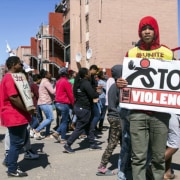
These corrupt activities translate into “disruptions in the provision of essential services, which can have health, environmental and economic consequences. Corruption scandals and service delivery challenges also result in an erosion of public trust, leading to protests and disengagement from participatory democratic processes”.
We have already seen a notable withdrawal in public interest in electoral and political matters. Research by the Human Sciences Research Council (HSRC) revealed in mid-2025 an all-time low level of public trust in politicians and political parties, and a consequent widespread uninterest in politics in general.
“Trust in political parties and politicians is low, with only 17% and 14% of the adult public, respectively, expressing confidence in them. Political disengagement is also prevalent, as most South Africans (including party members) show little interest in politics,” said the HSRC at the time.
In an election year, where every vote should count, this is a situation that must be addressed with urgency.
So is this organised crime?
In their 2011 research paper titled Links between Corruption and Organised Crime, and Research Gaps, Michael Levi and Nicholas Lord of the School of Social Sciences at Cardiff University points out the “common misconception that ‘organised crime’ applies only to per se illegal activities such as drugs trafficking”.
The authors add that in fact, any criminal activities can in principle be the basis for the label. “Thus one might define as organised crime an alliance between corrupt leaders (elected or not), family members, and others (perhaps including the police or military) to embezzle funds from national treasuries or even to extract monopoly profits from superficially legal businesses, provided that they can violate some criminal law in doing so.”
Sigsworth therefore argues that most of the behaviours and activities outlined in the policy brief meet many of the criteria for corruption and organised crime.
“They involve illegal acts carried out by groups or networks of individuals who coordinate their actions and misuse entrusted power to obtain financial or material benefits for private gain. As such, it is useful to ask what factors shape the organisation of certain types of corruption, who becomes involved and how they are drawn in.”
The more organised corruption is, she says, the more it erodes governance and enables criminal enterprises to grow because organisation is a powerful driver for corruption – “allowing it to operate smoothly, bypass obstacles and expand its reach into legitimate systems”.
The state thus fails on the level that most directly affects ordinary people’s everyday lives, says Sigsworth, “weakening service delivery and degrading quality of life”.
Recommendations
It goes without saying that voters should always be aware of how the people they entrusted with power are living up to that trust, so they may be held accountable for failures and successes. A Corruption Watch project – Strengthening Action Against Corruption (SAAC) – run in collaboration with Social Change Assistance Trust and Transparency International, is currently targeting community advice offices and civil society organisations in the Eastern Cape province, equipping them with the knowledge and resources needed to identify and address corruption in their municipal areas.
Local government in the Eastern Cape province has been particularly impacted by corruption, with the Hawks conducting investigations in 17 of 39 municipalities since 2022. Public officials in informal syndicates, often with service providers, manipulate procurement systems to misappropriate funds, mirroring patterns seen in national high-profile corruption cases. This ongoing systemic corruption has contributed significantly to South Africa’s struggle with socio-economic challenges and weak governance.
By supporting these organisations in mobilising their communities, SAAC fosters a culture of accountability and transparency that is fundamental to anti-corruption efforts in the country.
Sigsworth’s policy brief makes some specific recommendations, including:
• Identify key actors: who is involved in organised corruption at the local level and what roles do they play?
• Map relationships and networks: how are actors connected and what forms of structure or hierarchy exist within these networks?
• How do these relationships link local government officials and private sector actors?
• To what extent are these ties formal or informal?
• Analyse organisational processes: how is corruption coordinated and maintained?
• Are these processes organic, structured or a combination of both?
• How do they operate across public and private sectors?
• Examine benefits and incentives: what advantages do actors gain, and how are these accrued, distributed, concealed and used?
• Address accountability gaps: in many cases, lower-level participants are prosecuted while organisers evade responsibility. What measures can ensure accountability for those orchestrating corruption?
• Design effective interventions: what mechanisms for prevention, early intervention and law enforcement can disrupt organised networks and address systemic vulnerabilities?